
When your Labrador trembles, pants, or hides as fireworks explode, it’s one of the most helpless feelings in the world.
You want to comfort them — but you also wish you could explain, “It’s just noise, you’re safe.”
Fear like this is your Lab’s nervous system doing what it’s wired to do — trying to survive something it doesn’t understand.
The good news? With patience, empathy, and a calm, steady approach, you can gently teach your Lab that those sounds aren’t dangerous after all.
This process is called desensitization and counter-conditioning, and it takes time — weeks or even months. But it works.
1 Don’t push them through it — rebuild from safety
If your Labrador is already scared, “getting them used to it” by exposing them to loud noises will only make things worse. You can’t push fear out. You have to invite calm in.
Start far below their fear threshold — that means a distance, volume, or situation where they notice the sound but still stay relaxed enough to eat, play, or wag.
Then, at that gentle level, pair every small noise with something wonderful: a handful of treats, a soft voice, or a few seconds of play.
If they stiffen, stop eating, or try to leave, you’ve gone too far. Lower the intensity and start again later.
This is a marathon, not a sprint. But every time your Lab stays calm through a mild sound, their brain rewires a little more toward safety.

2 Turn noise training into a calm game
Think of it as sound play, not sound therapy.
You can start with a fireworks or thunder playlist on YouTube or Spotify — but remember: digital recordings only reproduce sound, not vibration.
Many Labradors who panic at real fireworks stay completely calm when they hear them through speakers, even at full volume. That’s because real fireworks create deep, physical vibrations in the ground and air — something your Lab can feel through their paws and chest.
So while playlists are a great first step, it helps to mix in gentle real-world sounds too.
For example:
🎈 Pop a balloon from a distance (start small!).
🍽️ Drop a metal spoon into the sink.
🚪 Let a friend close a door firmly in another room.
Every small, safe sound your Lab hears — followed by calm praise or a treat — teaches their brain: “Noise happens, and I’m still okay.”
Here’s how to keep it gentle and game-like:
🎵 Play soft sounds while your Lab is doing something they love — chewing, sniffing, or training.
🎯 Increase volume and variety slowly, over weeks not days.
💛 End each session on calm, relaxed energy.
If your Lab stays loose, happy, and connected with you, that’s success.
Consistency beats intensity — just a few peaceful minutes several times a week can slowly turn fear into confidence.
3 Let sniffing and chewing do the healing
Labradors process the world through their senses. Sniffing, chewing, and licking aren’t distractions — they’re powerful tools for regulating emotion.
These simple activities release serotonin and oxytocin, which lower stress and help your Lab self-soothe:
🦴 Long-lasting chews or stuffed Kongs
🌿 Snuffle mats or “find it” games
🍯 Lick mats with yogurt or peanut butter
Use them during sound sessions or right after something startling. They help your Lab’s brain shift from panic to peace.

4 Comfort isn’t “rewarding fear” — it’s meeting a need
There’s a myth that comforting a frightened dog “teaches them to be scared.”
That’s not true — fear isn’t a behavior we can reinforce. It’s an emotion that needs support and safety.
If your Lab comes to you for comfort, give it freely:
Speak softly, pet them with slow, gentle strokes, and breathe deeply. Your calm voice and touch release oxytocin in both of you — literally telling their brain, “You’re safe now.”
But don’t push contact. Some dogs prefer space while they process.
In that case, simply sit nearby, keep your energy grounded, and let your presence do the comforting.
The message you want to send is:
💛 “You don’t have to face this alone, and I’ll stay calm no matter what.”
That’s what builds true trust.
5 Build emotional safety through daily routines
The calmer your Lab feels in daily life, the more resilient they’ll be when things get loud.
Predictability is one of the greatest gifts you can offer a sensitive dog.
Keep feeding, walking, and rest times as consistent as possible.
Add short focus-building games, like:
- “Find My Attention” (rewarding your Lab for checking in with you)
- “Fist Bump” (nose-to-hand touch for grounding connection)
These games teach your dog that calm focus brings good things — even when the world feels unpredictable.
6 Your calm energy is their anchor
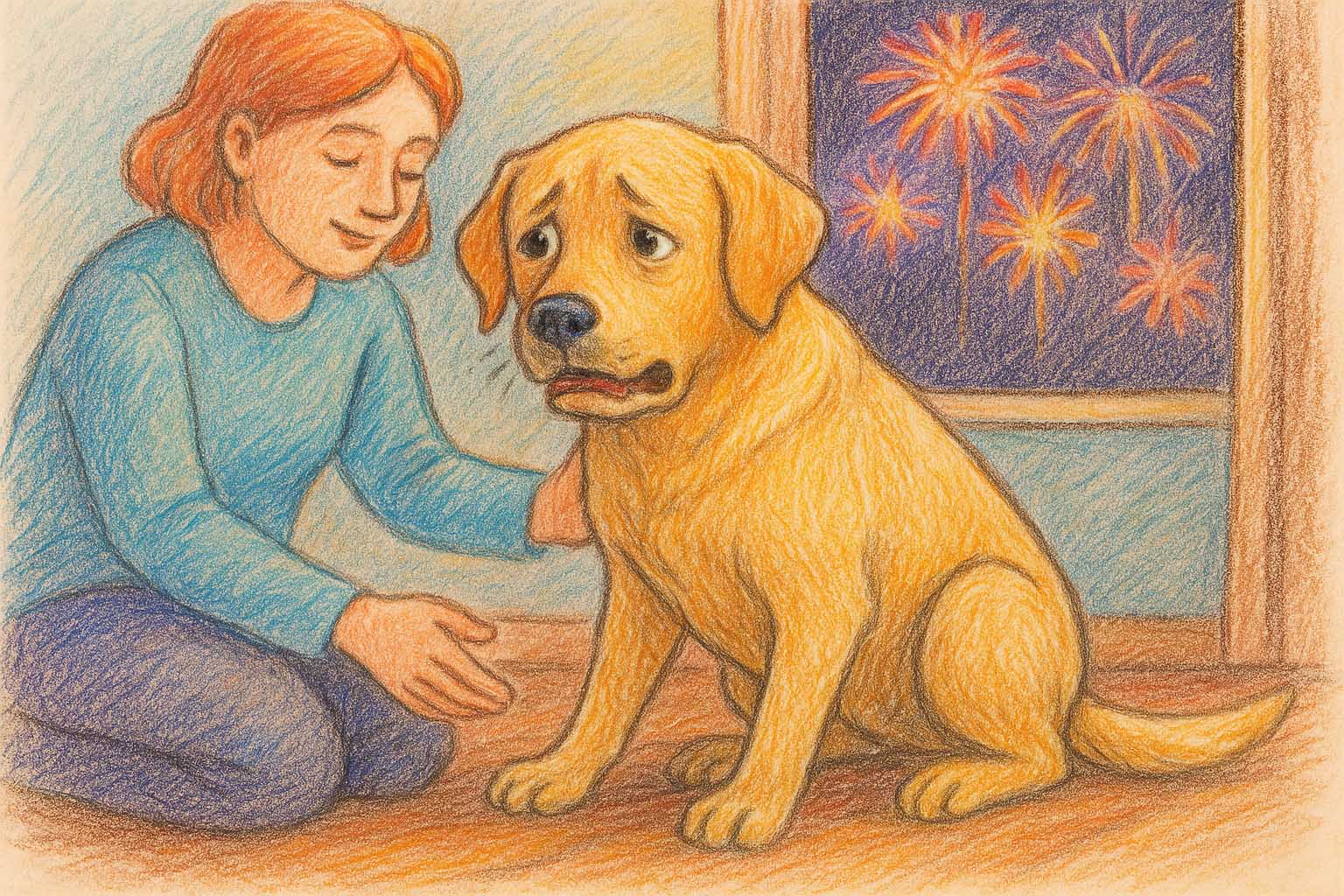
When your Lab is scared, they read your body before they hear your words.
If you tense up, hold your breath, or start pacing, they’ll take that as confirmation that danger is real.
So the next time fireworks start, try this:
- Take a slow, deep breath.
- Loosen your shoulders.
- Speak softly and move slowly.
- If they come close, rest your hand gently on their side — no squeezing, no fussing, just calm presence.
You don’t have to convince them with words. You just have to be their calm.
7 Never punish or scold fear
If your Lab barks, shakes, or hides, they’re not being “dramatic.” They’re struggling to cope.
Punishing or ignoring them will only confirm their belief that fireworks = danger.
Instead, offer quiet reassurance, create distance from the sound, and focus on rebuilding trust.
Because fear fades only when safety grows.
The key takeaway
Desensitizing a scared Labrador takes time, repetition, and patience — but it works.
Every calm experience, every gentle exposure, every deep breath from you helps rewire fear into confidence.
Your Lab doesn’t need to be fearless.
They just need to know that no matter what they hear, you’ll stay steady — and that’s what makes them brave.